

随着人口增长导致的需求增加,以及全球变暖导致水资源减少,全球饮用水都面临着巨大的压力,尤其是在干旱和半干旱地区。如何更加高效便捷的获取饮用水已经成为重要的研究方向。
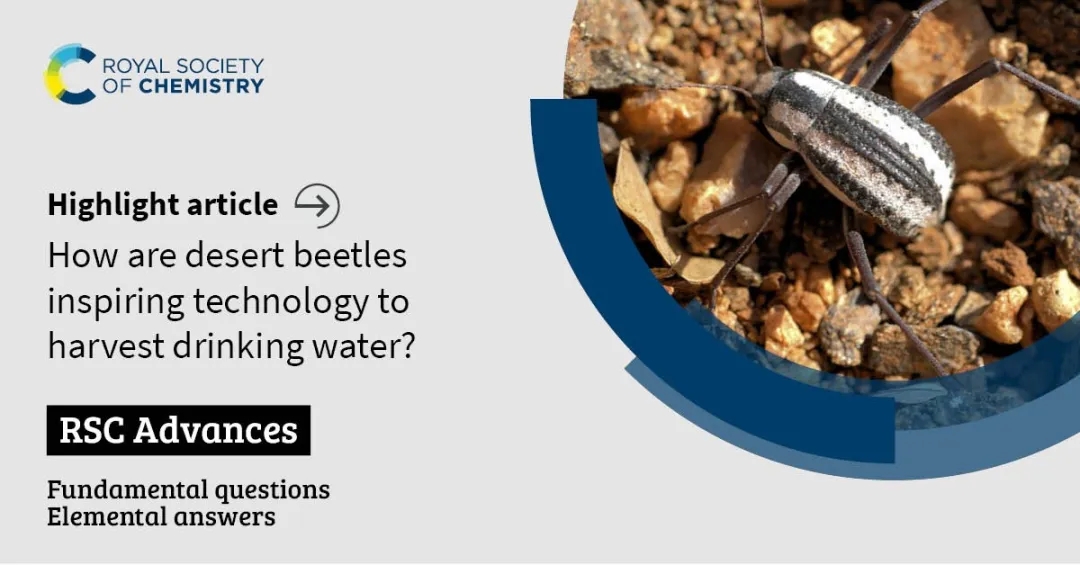
甲虫背部的隆起促使雾气形成水滴。随后水被导入甲虫的嘴里,使其能够在西南非洲干燥的荒野中生存。东南大学张友法、余新泉与同事们一道从沙漠甲虫凹凸不平的表面获取灵感,开发了水分收集的新技术。相关研究工作发表在 RSC Advances 上。这种从空气中凝结水的系统为世界上急需用水的干旱和半干旱地区提供了一种廉价而有效的饮用水获取途径。
论文信息
Beetle-like droplet-jumping superamphiphobic coatings for enhancing fog collection of sheet arrays
Xikui Wang, Jia Zeng, Xinquan Yu*(余新泉,东南大学), Caihua Liang and Youfa Zhang*(张友法,东南大学)
RSC Adv., 2020
http://dx.doi.org/10.1039/C9RA09329J
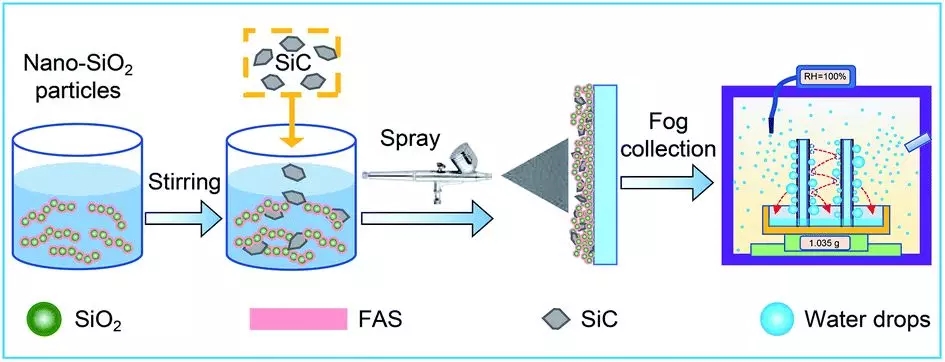
为了模拟甲虫的这种集水方法,研究人员向涂覆在铝板上的超疏水二氧化硅涂层中添加了由碳化硅颗粒制造一种混合材料。这样就形成了一个粗糙的表面,上面散布着相互作用的亲水区域和疏水区域,崔进了微小水滴的形成。
通过将两层合成材料紧密贴合,可提高其集水能力。值得注意的是,作用在最小液滴上的力使它们跳离表面并发生碰撞。这使得该系统从空气中吸水的效率是单层表面的两倍以上。
此外,与其它从空气中集水的方法相比,本文报道的系统更加易用和经济。
除了为新型集水装置的开发铺平道路,研究人员也期待发掘这一工作在海水淡化、换热和水质净化等领域的应用。
关于 RSC Advances At the heart of open access for the global chemistry community RSC Advances 该刊是化学领域发文量最大的开放获取期刊,发表高质量、专业性的论文, 报道能推动化学及相关学科进步的研究进展。该刊所发表的论文应给出足够的证据/数据来支持结论,对所报道的材料/化合物要进行充分的表征,还要和已发 表过的相关工作进行比较已表明该工作确实是相关领域的新进展。 IF: 3.049 *
Editor-in-chief
Russell Cox
Leibniz Universität Hannover, Germany
Editorial Board Member
James Batteas
Texas A&M University, USA
Karen Faulds
University of Strathclyde, UK
Young-Shin Jun
Washington University in St Louis, USA
Tapas Kumar Maji
JNCASR, India
Manuel Minas da Piedade
University of Lisbon, Portugal
Heloise Oliveira Pastore
UNICAMP, Brazil
Norio Shibata
Nagoya Institute of Technology, Japan
Stacey Wetmore
University of Lethbridge, Canada
Qingdong Zheng
Chinese Academy of Sciences, China
郑庆东,中国科学院
Assiociate editor
All submissions to RSC Advances are now handled by our international team of associate editors with representation from across all areas of the chemical sciences.
Scope The criteria for publication are that the work must be high quality, well conducted and advance the development of the field. Articles submitted to the journal are evaluated by our international team of associate editors and reviewers for the overall quality and accuracy of the science presented. Please ensure you have considered the following points before submitting your manuscript. Does the work present a significant advance over the existing literature? Please supply a covering letter with your submission to demonstrate how the work is advancing the field over the existing literature. Have you provided sufficient evidence/data to support your conclusions? Have you provided adequate characterisation data for your materials/compounds? (Please check the supporting information section to ensure that the necessary requirements have been met and copies of relevant spectra have been provided where necessary.) Are the results discussed in the context of the literature? Are the references relevant and do they appropriately reflect the existing literature?


 津公网安备 12010102000028号
本站推荐IE8.0及以上浏览器1024×768以上分辨率浏览
津公网安备 12010102000028号
本站推荐IE8.0及以上浏览器1024×768以上分辨率浏览

